Mehran Rezvani, who grew up in Iran during the Islamic Revolution, has become a devoted supporter and volunteer for Israel.

‘Truth is stranger than fiction” goes the time-tested saying coined by Lord Byron in 1823.
The relevance of that quote crossed my mind recently when I interviewed perhaps one of the most unlikely volunteers in Israel today: 60-year-old Mehran Rezvani, who was born and raised in Qaem Shahr, one of the largest cities in northern Iran.
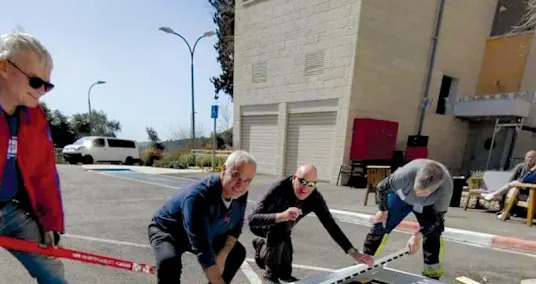
Rezvani is part of a group of eight Norwegian volunteers at the Eitanim Mental Health Center outside Jerusalem, on behalf of Nachamu Nachamu Ami, a Dutch organization that provides humanitarian assistance to Jewish people in the Diaspora and Israel.
My phone interview was conducted with Rezvani and assisted by his fellow volunteer Kenneth Reinhardtsen, who translated his remarks from Norwegian to English.
Rezvani was 14 when the Shah of Iran was overthrown and Ruhollah Khomeini came to power. He was indoctrinated with the anti-Israel and antisemitic feelings that swept through Iran at that time; but as he grew older, he became disenchanted with the political system in Iran.
In 1986, Rezvani, a member of the Iranian weightlifting team, competed in the Asian Games in Seoul and won a bronze medal. During his stay in South Korea, Rezvani defected from Iran with three other team members and settled in Norway. Rezvani said that he chose Norway because he was told that he would be safest there from Iranian agents who might try to harm him.

After moving to Norway, he joined the country’s weightlifting team and won a gold medal at the 1990 Nordic Weightlifting Championships.
In 1995, he said, his life changed. “I started to read the Bible, and I began to believe what was written. I had been taught previously that Israel was a negative nation and the Jews were evil. But when I read the Bible, I received an entirely different perspective.” Rezvani’s views on Israel and the Jewish people changed 180 degrees.
Rezvani became a Pentecostal Christian, married a Norwegian woman, and now has three children and two grandchildren. He lives with his family in Bergen, Norway’s second-largest city, located on the west coast. He once operated a restaurant in Oslo, and today he and his wife run a company that provides coaching services.
In mid-February, he arrived in Israel on a visit and is performing maintenance work at Eitanim. After the war began on February 28, he said, his friends and family in Iran were encouraged. “They were waiting for America and Israel to help them, but then they got help and were very happy.” However, he continued, the Internet has been shut off in Iran, and he can no longer be in touch with his friends and relatives there.
Rezvani is hopeful that the regime will fall, expressed his extreme distaste for the ayatollahs and the Revolutionary Guards, and added that his family in Iran feels the same way.
Along with the other volunteers, Rezvani works five days a week in Eitanim and is enjoying his visit here, despite the war. He is planning to remain in Israel until mid-May and is staying in Kfar Shaul. He enjoys Israeli cuisine and has grown fond of the Israeli people and the atmosphere.
'When missiles fall, we take it very easy'
Judith Levin, head psychologist in the psychogeriatric unit at Kfar Shaul Mental Health Center, is grateful for assistance from volunteers such as Rezvani. “I always feel a lift when I see the overseas volunteers. I respect the quiet, hard work they do and, most of all, their support for Israel, even when the leadership in their own country might be less than supportive,” she said.
When asked about leaving his family for such an extended period of time, Rezvani replied, “My wife is in Norway, and she doesn’t mind that I am in Israel. She believes in the God of Israel and knows that He protects the country and His peace is upon Israel.
“The people here are very friendly,” Rezvani chuckled. “When I was visiting the Old City, a police officer asked me where I was from. I said I was from Iran, and at first I was a bit concerned. But he was very friendly to me.”
As our conversation came to a close, I asked Rezvani how he feels when he hears the sirens signaling the arrival of incoming missiles from his former home. “When missiles fall, we take it very easy. We feel safe, and we are not worried,” he stated.
It would seem impossible that a 14-year-old growing up during the Islamic Revolution could become a devoted supporter and volunteer for Israel. But as Mark Twain said, expanding on Byron’s famous words, “Truth is stranger than fiction. But it is because fiction is obliged to stick to possibilities; truth isn’t.”
LATEST POSTS
- 1
 Before Cheap Cars Were Common, This Fiat Changed Everyday Life for Millions
 - 2A Couple of Modest Guitars for 2024
- 3Party Urban areas of the World
- 4What’s the shadowy organisation taking Gaza Palestinians to South Africa?
- 5Satellite constellations could obscure most space telescope observations by late 2030s: 'That part of the image will be forever lost'



- Huge rotating structure of galaxies and dark matter is detected
- Do-It-Yourself Home Style on a Careful spending plan: Imaginative Thoughts and Tasks
- Data centers in space: Will 2027 really be the year AI goes to orbit?
- Could the Star of Bethlehem have actually been a comet?
- Blue Origin’s New Glenn rocket landed its booster on a barge at sea – an achievement that will broaden the commercial spaceflight market
- Only 30% of young people in Israel optimistic about future, Aluma survey reveals
- Plane Passenger Allegedly Includes ‘Bomb Threat’ in Hotspot Network Name, Forces Flight to Make Emergency Landing
- At least 55 injured in Russia after train crashes, overturns
- Beyond oil: The crucial exports blocked by Hormuz closure