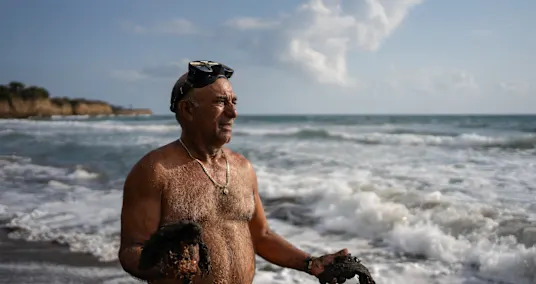
MEXICO CITY (AP) — An oil spill in the Gulf of Mexico in early March spread more than 600 kilometers (373 miles), including to seven nature reserves, and originated from a vessel yet to be identified and two “natural seepages,” Mexican authorities announced Thursday.
Authorities, however, ruled out the possibility of severe environmental damage from the spill off coast of the eastern state of Veracruz.
The release of the preliminary findings came after weeks of controversy surrounding the lack of transparency in the case.
Navy secretary, Admiral Raymundo Morales, said satellite image analysis and inspections of the area identified three sources of the spill: a vessel anchored off the coast of the port city of Coatzacoalcos, in the eastern state of Veracruz; a geological site where crude oil naturally seeps, known as a “chapopotera,” located 8 kilometers (5 miles) from that port; and another natural seepage located in the Bay of Campeche.
Morales said at a press conference that the vessel has not yet been identified because, as of early March, there were 13 ships sailing in the area that had not yet been inspected.
He also admitted that the source of the spill “remains active,” and that one of the main sources is estimated to be the “natural seeps in Cantarell, in the Bay of Campeche.”
“These oil seeps have a constant, natural emission; however, there has been a greater flow of contaminants in the last month,” he said.
Five months earlier, heavy rains and flooding caused a pipeline rupture and a spill, also in Veracruz, that extended for 8 kilometers (5 miles) along the Pantepec River.
In the March spill, Morales reported that the oil covered an area of about 600 kilometers (373 miles) including 200 kilometers (125 miles) of coastline in the southern states of Veracruz and Tabasco. To date, “430 tons of hydrocarbons” have been collected.
Secretary of the Environment Alicia Bárcena reported that the spill affected seven protected natural reserves in the states of Veracruz and Tabasco, but insisted that “we have not detected severe environmental damage.”
Environmental authorities have identified six species, including sea turtles, birds and fish, that were contaminated by the spill.
The National Commission of Natural Protected Areas (Conanp) reported Wednesday in a statement that hydrocarbons have been collected in the Los Tuxtlas Biosphere Reserve, the Veracruz Reef System National Park, the Lechuguillas Sanctuary, the Totonacapan Beaches Sanctuary, the Lobos Tuxpan Reef System Flora and Fauna Protection Area, and south of the Rancho Nuevo Beach Sanctuary in the state of Veracruz. Cleanup efforts were also carried out in the Centla Wetlands Biosphere Reserve in the state of Tabasco.
The international organization Oceana, dedicated to ocean conservation, said this week in a statement that, according to reports from communities belonging to the Gulf of Mexico Reef Corridor Network, the spill killed sea turtles, a manatee and various fish species, and damaged 17 reefs.
___
Follow AP’s Latin America coverage at https://apnews.com/hub/latin-america
LATEST POSTS
- 1
 Lecturer who called Israel a terrorist state to remain Plaid Cymru candidate
 - 2Why More Couples Are Choosing Africa For Their Honeymoon
- 3South African radio presenter among five charged over Russia recruitment plot
- 4Journey through Pages: A Survey of \Plunging into Scholarly Universes\
- 5After toilet and email issues, Artemis II astronauts fire engine to head for the moon




- Most loved Occasion Dish: What Makes Your Merry Table?
- Obamacare enrollment declines as US subsidies expire
- Human evolution’s biggest mystery has started to unravel. How 2025 tipped the scales
- A Sweet Choice: Pick Your #1 Cake!
- Peruvian ex-President Martin Vizcarra sentenced to 14 years in prison
- Nine in 10 German industrial firms expect Iran war to hit business
- One perk to marrying Richard Marx later in life? 'We don't have time' for stupid arguments, says Daisy Fuentes.
- Machado ‘presented’ her Nobel Peace Prize medal to Trump
- Tesla Stock Hasn’t Looked This Cheap in a While