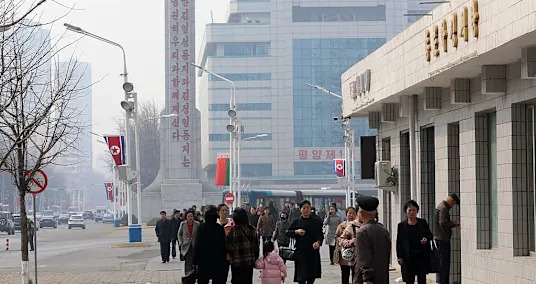
China has announced that its flag carrier, Air China, will resume direct flights to North Korea after a six-year pause, following the restoration of passenger train services between Beijing and Pyongyang.
This marks a significant step toward reopening North Korea, one of the world's most isolated nations, to the world.
Transport links between the two capitals had been suspended since the start of the Covid-19 pandemic in 2020, when Pyongyang implemented a very strict border closure.
While North Korean carrier Air Koryo already resumed flights to Beijing in 2023 and allowed Russian tour groups to visit in 2024, the return of China's air and railways are seen as a major economic milestone, as China has for decades been the main trading partner and a key source of diplomatic and economic backing for the country of 26 million people.
Before the pandemic, there were an estimated 300,000 foreign visitors in 2019, according to South Korea's Institute for International Economic Policy, and Chinese visitors accounted for 90% of all tourists to North Korea. Therefore, the long delay in resuming regular travel had surprised many regional observers.
"The reopening of these borders has been driven primarily by Pyongyang's timeline, which challenges the outdated assumption that Beijing dictates terms to a dependent client state," Seong-Hyon Lee, a visiting scholar at the Harvard University Asia Centre, explains.
Related
Nuclear ambitions complicated the relationship
Despite being Pyongyang’s primary ally, Beijing has frequently voiced disapproval over the North's persistent missile tests and nuclear ambitions. This aspect created a bumpy relationship with Pyongyang, with analysts saying that a nuclear-armed North Korea has often been something of a liability.
The diplomatic normalisation was highlighted last September, when Kim Jong Un attended a massive military parade in Beijing alongside Russian President Vladimir Putin. This was Kim's first appearance at a Chinese military display.
Lim Eul-chul, a North Korea expert at South Korea's Kyungnam University, argues that the war in Iran, in particular, increased "the need for closer coordination between the two nations".
LATEST POSTS
- 1
 Reconnecting with an old friend is a story of distance, loss and rediscovery
 - 2Crew-11 astronauts undock in 1st-ever medical evacuation from the International Space Station (video)
- 3Instructions to Help a Friend or family member Determined to have Cellular breakdown in the lungs
- 4Step by step instructions to Remain Spurred While Chasing after a Web-based Degree
- 5The Development of Shipping: Controlling Towards a More Associated Future


- 6 Web-based Course Stages for Successful Learning and Educating
- Barry Manilow to have surgery for early-stage lung cancer and postpones January concerts
- Vote In favor of Your #1 sort of film
- A coup too far: Why Benin's rebel soldiers failed where others in the region succeeded
- Fundamental Home Exercise center Hardware: Amplify Your Exercises
- Astronauts head home early after medical issue
- How stripping diversity, equity and inclusion from health care may make Americans sicker
- 7 Powerful Techniques to Boost Efficiency with Your Cell Phone: A Thorough Aide
- In these U.S. groups, deaths now exceed births. What’s happening?